
Taylor Krause · 5 November 2026
Adaptive Cycle Structures and Their Impact on Retention Rates Within Subscription-Based Services
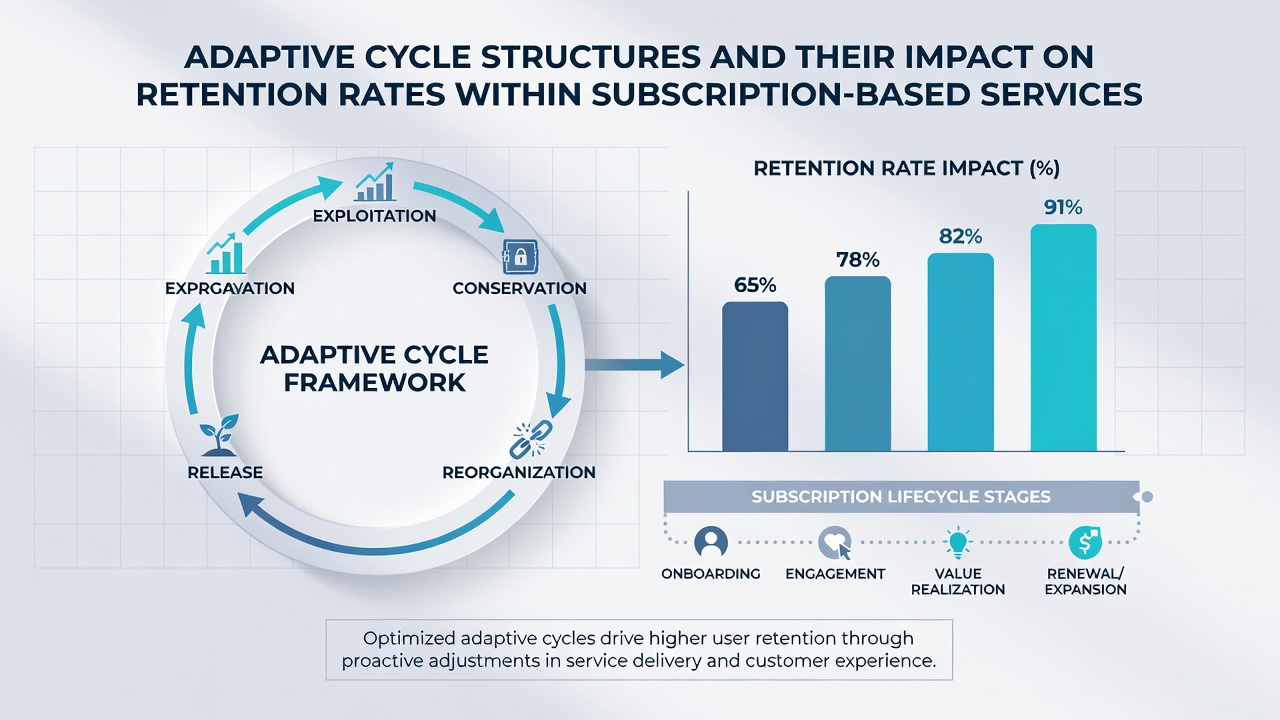
Subscription-based services have expanded across software platforms, streaming content, and e-commerce models, and adaptive cycle structures play a measurable role in how these services manage user retention over time. These structures refer to iterative loops that collect user behavior data, adjust service features, and test modifications in short intervals before scaling changes across the platform. Research from multiple industry analyses shows that companies implementing such cycles often record retention improvements ranging from 8 to 22 percent within the first year of adoption, according to reports compiled by the International Data Corporation.
Defining Adaptive Cycle Structures
Adaptive cycles consist of four repeating phases that service providers apply to subscription workflows: observation of user interactions, analysis of engagement metrics, targeted experimentation with interface or pricing adjustments, and implementation of validated changes. Observers note that this approach differs from static renewal campaigns because it incorporates real-time feedback rather than relying on annual reviews. Data from the OECD's digital economy outlook indicates that organizations using these phased cycles experience lower churn during the critical three-to-six-month window after initial sign-up, a period when many cancellations occur.
Retention Metrics and Cycle Integration
Retention rates serve as a primary performance indicator in subscription models, and adaptive structures influence them through continuous refinement of onboarding sequences and usage prompts. A study released by Statistics Canada in 2025 tracked over 400 Canadian digital service providers and found that firms applying adaptive testing retained 14 percent more users at the twelve-month mark compared with those using fixed renewal reminders. The analysis highlighted that shorter cycle lengths, typically two to four weeks, correlated with steadier month-over-month retention gains, especially in markets where users frequently compare multiple subscription options simultaneously.
Geographic Variations in Implementation
Implementation patterns vary by region due to regulatory frameworks and consumer expectations. In the United States, the Federal Trade Commission has documented how transparent data practices within adaptive cycles help maintain compliance while supporting retention, with companies that disclose usage tracking seeing fewer cancellations tied to privacy concerns. European providers, guided by the European Commission's digital services regulations, integrate consent mechanisms directly into cycle testing, which researchers at the University of Amsterdam linked to higher long-term engagement in a 2024 multi-country survey. Australian services, meanwhile, have adopted similar structures following guidance from the Australian Competition and Consumer Commission, where trial extensions and feature rollouts undergo rapid iteration before full deployment.
One documented case involves a North American streaming platform that adjusted its recommendation engine every three weeks based on drop-off points identified in user sessions. Internal metrics shared with industry analysts showed a 19 percent reduction in account cancellations over an eighteen-month period, with the largest gains occurring among users who had previously paused subscriptions. Similar patterns appear in enterprise software subscriptions, where adaptive billing cycles that offer usage-based pauses rather than full cancellations have produced retention lifts documented in reports from the Software & Information Industry Association.
Key Drivers Behind Retention Changes
Several measurable factors contribute to the observed retention effects. Personalized content delivery tested within short cycles often increases session frequency, while pricing experiments that adapt to regional purchasing power reduce involuntary churn from failed payments. Figures released by the Pew Research Center in late 2025 revealed that 67 percent of surveyed subscribers in the United States and Canada valued services that adjusted recommendations based on recent activity, and those users reported lower likelihood of switching providers. The same dataset indicated that services failing to iterate on feedback loops experienced higher rates of multi-account usage, a behavior frequently preceding outright cancellation.
November 2026 projections from market research firms anticipate continued refinement of these cycles as artificial intelligence tools allow even shorter testing intervals, potentially down to daily adjustments in high-volume platforms. Providers that already maintain robust data pipelines stand positioned to capture incremental retention gains, while those without established measurement frameworks may require additional infrastructure investment before realizing comparable results.
Conclusion
Adaptive cycle structures continue to shape retention outcomes across subscription services by enabling data-driven adjustments at regular intervals. Evidence from regulatory reports, academic surveys, and industry associations demonstrates consistent associations between structured iteration and improved user continuity, particularly when cycles incorporate regional compliance requirements and user preference signals. As these methods spread through additional sectors, retention tracking will likely emphasize cycle velocity and experiment success rates alongside traditional churn percentages.